
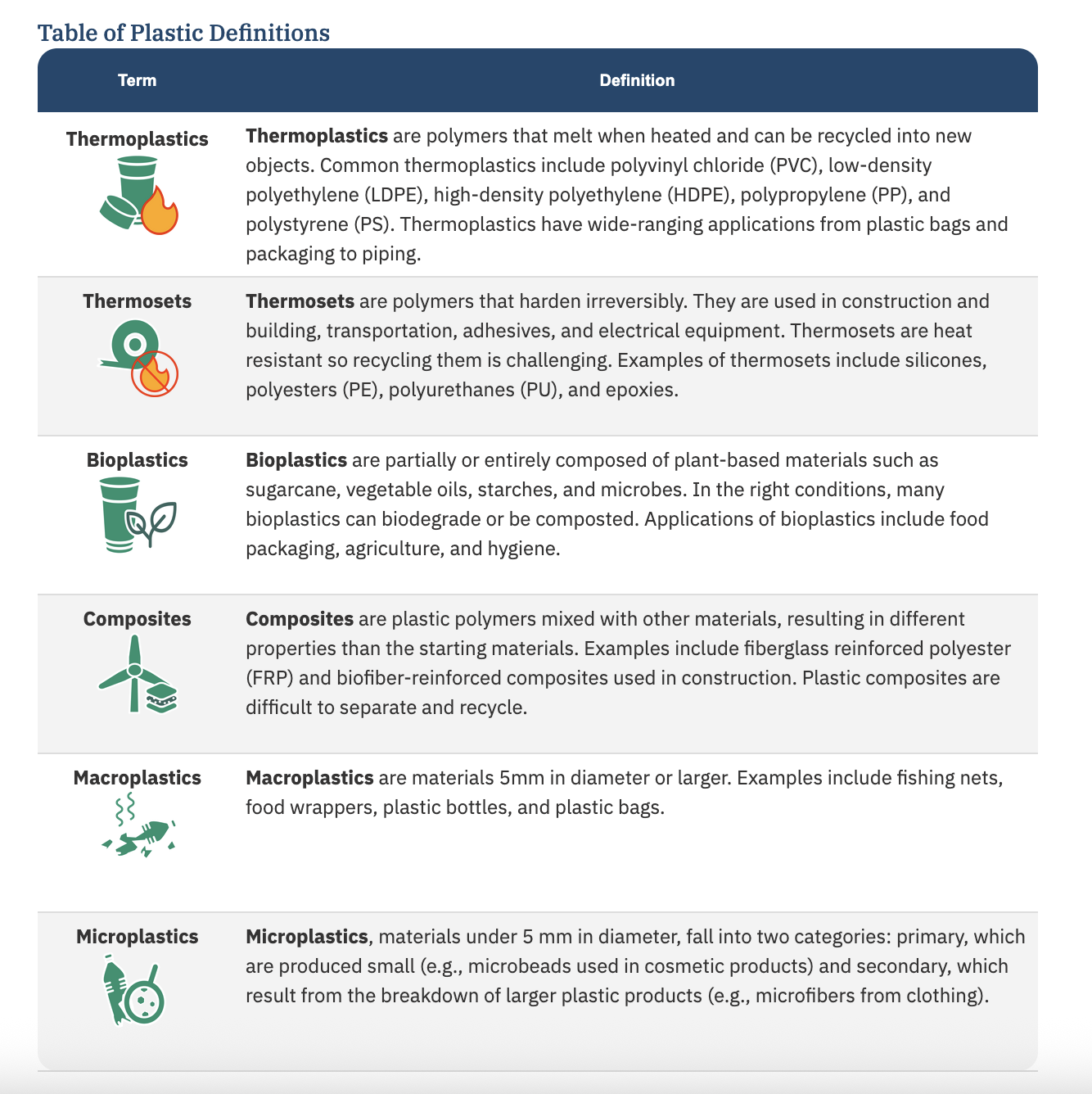
Plastic pollution is a critical environmental challenge and poses a threat to freshwater and marine systems where organisms are at risk for ingesting plastic or becoming entangled in plastic pollution. Once in the environment, plastic is persistent and depending on environmental conditions may take between 100 and 1000 years or more to decompose (source: https://www.epa.gov/plastics/impacts-plastic-pollution). There are many forms of plastics as summarized in the table below (source: University of Michigan, Center for Sustainable Systems; https://css.umich.edu/publications/factsheets/material-resources/plastic-waste-factsheet).
Americans alone discard more than 30 million tons of plastic a year and only 8% of it gets recycled (source: https://www.plasticpollutioncoalition.org/). The rest ends up in landfills, is burned, or becomes litter. An estimated 5–12 million tons of plastic pollution flows into our oceans each year (source: https://www.ellenmacarthurfoundation.org/the-new-plastics-economy-rethinking-the-future-of-plastics), choking wildlife and leaching toxic chemicals into the food chain that lead to disease and death. The health effects of plastics in our environment are described here (https://www.ciel.org/the-toxic-impacts-of-plastic-across-its-lifecycle/).
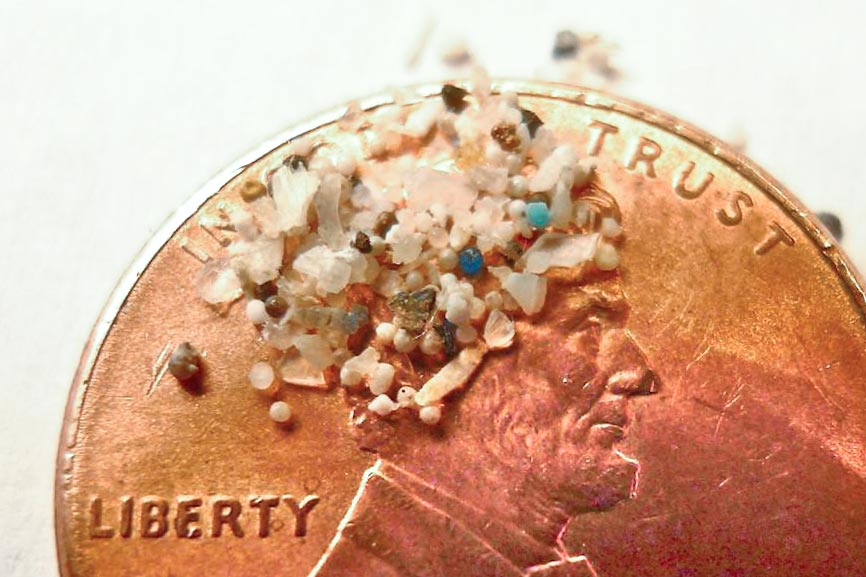
Plastic debris can come in all shapes and sizes. Once in the environment, plastic can fragment into smaller pieces. Microplastics are plastic particles ranging in size from five millimeters to one nanometer. Nanoplastics are plastic particles smaller than one micrometer (source: https://www.epa.gov/plastics/impacts-plastic-pollution). Microbeads, a type of microplastic, are very tiny pieces of manufactured plastic that are added as exfoliants to health and beauty products. These tiny particles easily pass through water filtration systems and end up in our waterways, posing a threat to aquatic life and entering the food web. The International Union for Conservation of Nature (source: https://iucn.org/sites/default/files/2022-04/marine_plastic_pollution_issues_brief_nov21.pdf) finds that carcinogenic chemicals found in plastic products can leach into tap water and might cause neurological and immune disorders. You can learn more about the science of microplastic pollution from Dr. Sherri Mason, a researcher studying plastic pollution (source: https://www.sherrimason.com/).
But do we have adequate recycling systems to tackle this colossal plastic pollution problem? Much of the world has grappled with a lack of investment in waste management infrastructure for too long. Our rivers, lakes, and oceans are filled with toxic plastic, choking, poisoning, and killing marine and human life.
Waterkeeper Organizations like those in California have successfully advocated for a ban on plastic bags (source: https://ballotpedia.org/California_Proposition_67,Plastic_Bag_Ban_Veto_Referendum(2016)). We need more efforts like this to reduce our consumption of plastic.
In addition to advocating for single-use plastic reduction and investment in waste management, Waterkeepers around the world are finding productive ways (source: https://waterkeeper.org/wp-content/uploads/2015/11/Waterkeeper-Alliance-Annual-Report-FY17-FINAL-WEB.pdf) to motivate their communities to clean up and prevent the plastic mess that litters our waterways.
Waterkeeper groups around the world are working together to make a difference to keep plastic pollution out of our oceans. You too can make a difference. Join us at waterkeeper.org/get-involved. And remember to reduce, reuse, and recycle.
A summary about plastic pollution is found here: (https://www.plasticpollutioncoalition.org/learn/plastic-pollution-facts)