The report below was prepared in 2025 for the Consortium. Its authors are Scott Kishbaugh, Retired NYS DEC Division of Water, and Robert Johnson, Racine-Johnson Aquatic Ecologists. Kishbaugh and Johnson serve as independent advisors to the Consortium. The significance of this report is its analysis of data representing a long-term record of lake aquatic plant and water quality conditions. Key findings from this analysis include:
- There is little evidence that herbicide applications are reducing the growth of Curley-leaf pondweed the following year, and these spring treatments may be impacting non-targeted native plants within and outside treated areas.
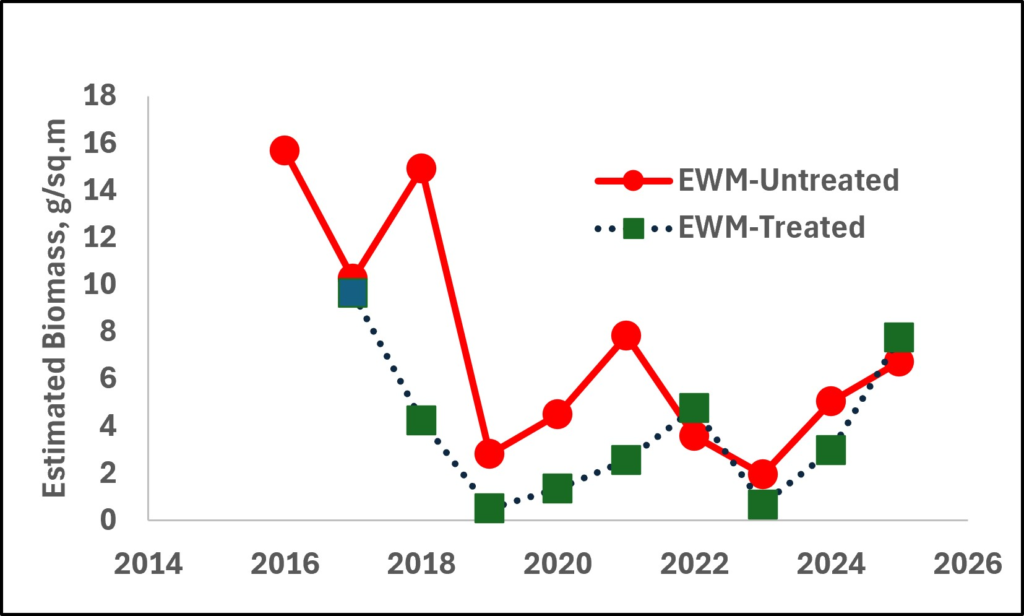
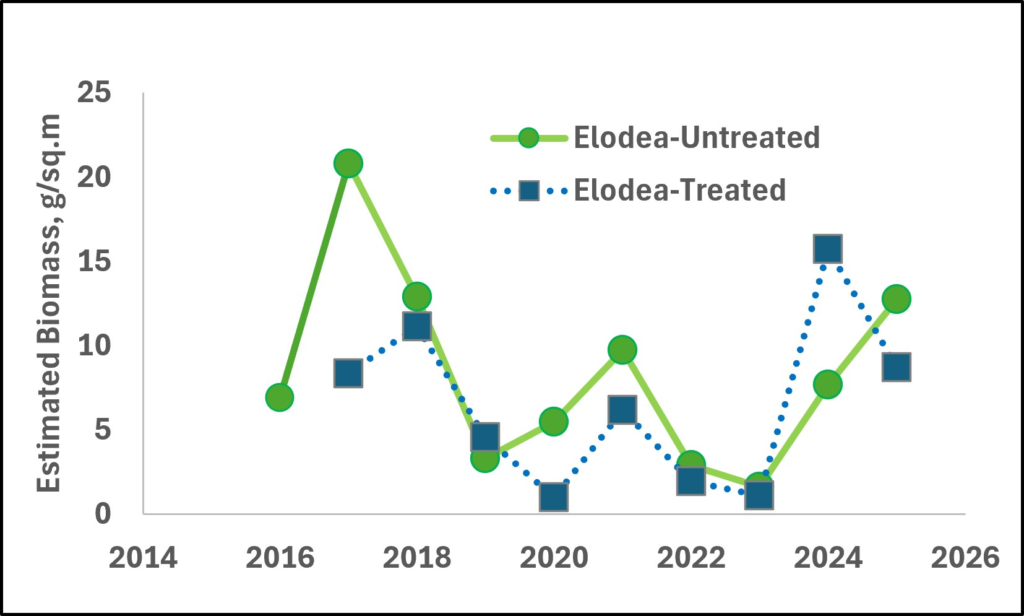
- Eurasian watermilfoil and non-targeted native plant biomass, particularly common waterweed (Elodea), appear to be changing in sync over time in both treated and untreated sites as shown in Figures 1 and 2. Both plants exhibited little change in the first few years of treatments, decreased significantly in the late 2010’s to early 2020’s, and increased in the last few years.
- Changes in Eurasian watermilfoil from herbicide applications are difficult to distinguish from control by insects or other non-herbicidal factors.
- The biomass of many native plants has decreased in herbicide-treated locations but has been more variable elsewhere.
- The Chautauqua Lake HAB season has started earlier in recent years and possibly exacerbated by herbicide applications.
- More areas have been observed in recent years where there are no plants growing.
In 2026, continuing analysis included another year of data. This analysis supported the 2025 report findings, and produced more information on HABs, species richness and changing plant communities identifying the need for further scrutiny of continuing treatments.
- Herbicide treatments cause vegetation to die and decay. The decaying of dead organic matter uses oxygen and results in release of nutrients into surrounding waters. It is possible that these nutrients contribute to early season algal blooms, such as the widespread bloom observed in May of 2026. This may be due to a release of nutrients coinciding with early growth and control of aquatic vegetation in spring, compared to natural die-off of these plants in mid summer. Late(r) season herbicide treatment can contribute to fall algal blooms by shifting this nutrient release from mid fall natural plant die-off to late summer herbicide-related die-off.
- Submersed aquatic vegetation sampling using methodology followed by SUNY Oneonta group shows similar or greater number of unique plant species or species richness (based on ~360 sites (or locations) collected every year) compared to North Carolina State University species richness (based on ~900-1100 sites (or locations) varying from year to year). Species richness would likely have been even higher in the SUNY Oneonta data if both programs surveyed the same number of sites. This discrepancy appears to be related to differences in rake toss methodology that might be missing vegetation that is living at the lake bottom or lower portion of the water column. These differences in survey methodology can skew the data, over-estimating some plants and under-estimating other plants, while changes in the lake can be more accurately evaluated from consistent methods and sites surveyed annually by SUNY Oneonta.
- Using data from 2025 provided by North Carolina State University it appears that there is more Eurasian watermilfoil in treatment areas compared to untreated areas. This suggests that herbicides are not reducing vegetation abundance as expected. Both Oneonta and North Carolina State University data suggest that there is an increase in sampling sites with sparse/no vegetation. This could suggest that the lake plant community structure is changing, rendering the lake more vulnerable to nutrient movement from the sediment to the water, future invasions from new plant species, and spread of these invasive species into recently cleared lake bottoms.